Failing Backwards: How Olympia’s "Gotcha" Game Drives Up Your Utility Bills
When you sit down at your kitchen table to balance the family budget, you know a simple truth: you cannot pay your bills with good intentions. You have to do the math. In communities across the 31st District—from Sumner and Orting to Buckley and South Prairie—working families are watching the cost of living run away from the average person. Every single dollar matters. You need clear numbers, predictable expenses, and a solid plan to survive.
“You cannot pay your bills with good intentions. You have to do the math.”
Unfortunately, the majority party that has been in charge of our state for the last 35 years does not operate by those same rules. They love passing massive, complicated laws just to grab a quick headline. But when it comes to the heavy lifting required to make those laws actually work, they disappear. We are failing backwards in Washington State because our leadership cares more about political public relations than real-world outcomes.
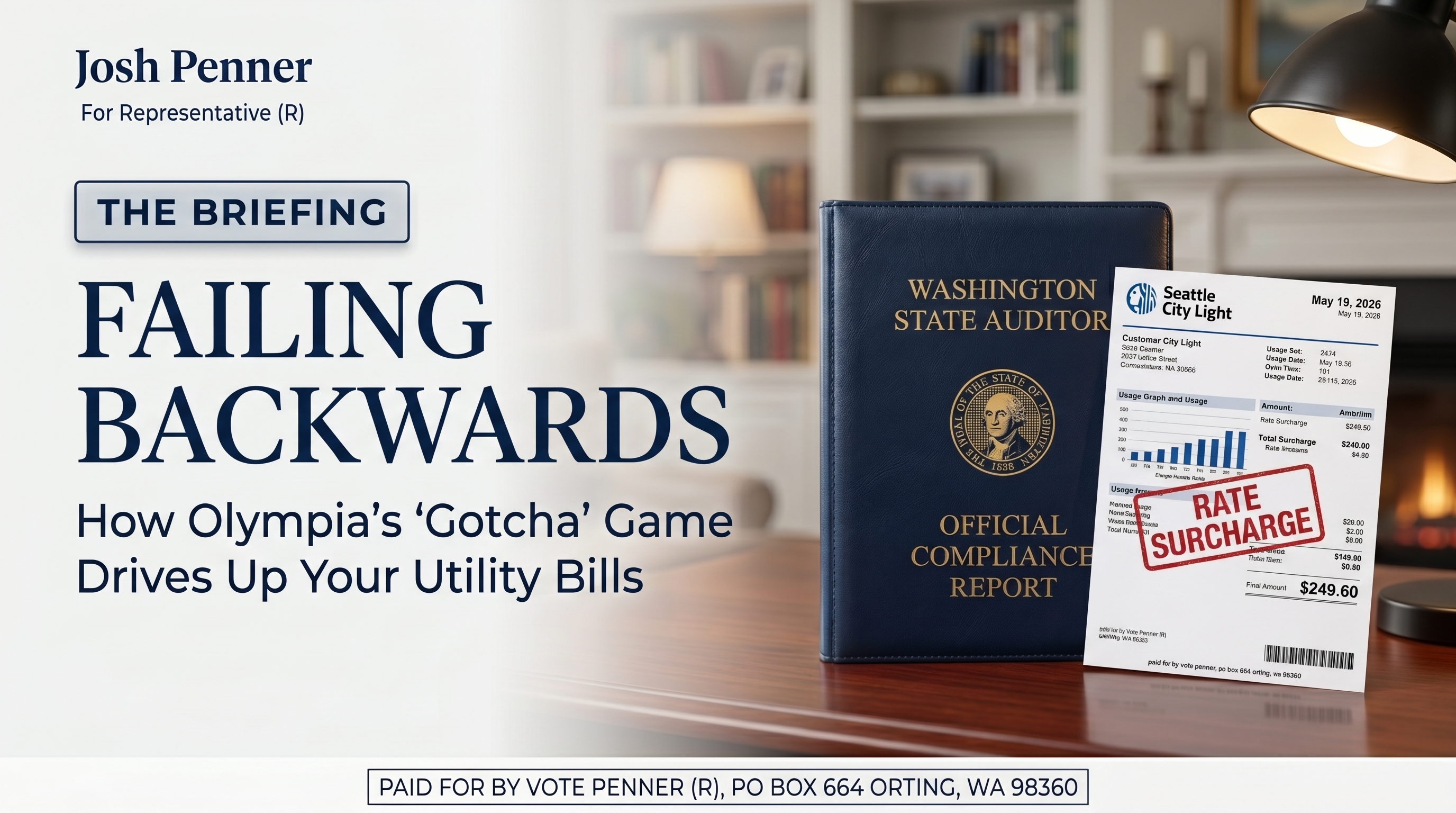
A perfect example of this broken machinery just came to light in official reports from the Washington State Auditor’s Office. If you only skimmed the news, you might think our local public utility districts and small city power companies simply mismanaged their operations. But when you look at the actual data, the real story looks much more frustrating. These reports do not expose local incompetence. They expose a state government that passes sweeping mandates, refuses to explain the rules, and then penalizes local communities for guessing wrong. It is a classic government gotcha game that leaves local ratepayers holding the bag.
The Anatomy of a Setup
To understand why this keeps happening to utilities across Washington, you have to look at how laws move from Olympia down to our neighborhoods. The majority party uses a predictable, unfair cycle:
The Performative Mandate (The Headline)
First, the Legislature passes a complex framework like the *Clean Energy Transformation Act*. The politicians get their press conferences and applause. Because the political benefit lies entirely in the headline, they leave the complicated math unwritten.
The Silent Bureaucracy (The Limbo)
Second, they hand the mess over to an executive agency, like the state Department of Commerce, and tell them to figure out the rules. The agency drags its feet, gives vague answers, or stays completely silent. Local utility managers are left in total limbo. They must keep your lights on today while guessing what the state will require tomorrow.
The Audit Trap (The Gotcha)
Finally, years down the road, a separate state office shows up to audit the local utility against strict, brand-new interpretations of the law. They find a discrepancy and slap the utility with a public penalty. The state traps local providers in a bottleneck of its own making. One agency ignores the utility, forces local managers to act without guidance, and then a separate state office publicly blames those managers for failing to read minds.
Look at the Literal Receipts
This is not just an opinion or a partisan talking point. The State Auditor's official compliance reports spell it out clearly.
City of Cheney
Electric Utility Compliance"City management said it was unable to obtain guidance from Commerce..."
Klickitat County
PUD No. 1 Audit Report"District management was unable to obtain clarifications or guidance..."
Pend Oreille County
PUD No. 1 ComplianceState legally requires complex 25-year projections, but agency refuses to supply mathematical formula.
Why This Matters Around Your Kitchen Table
When state agencies act with this kind of negligence, the consequences extend far beyond government red tape. It creates real financial pain for working families, causing local projects to take five times longer and cost twice as much as they should.
When the state issues a negative audit finding against a local utility, the cleanup costs money. Senior managers and financial teams must abandon their actual jobs of maintaining power lines and upgrading grid reliability just to handle compliance damage control. They have to spend your local tax dollars decoding riddles for a state agency that refused to answer their phone calls in the first place.
Even worse, these unfair reports damage the credit of well-run local institutions. Public utilities rely on clean financial records to get low-interest financing for major infrastructure projects. By publicly branding these utilities as non-compliant, Olympia actively drives up the cost of doing business. At the end of the day, those extra costs land directly on your monthly power bill.
Time for Adult Supervision
The systemic breakdown across our state proves that we have reached the absolute limit of Olympia's mandate culture. This current budget and policy cycle does less for more, and that scares me. We cannot keep running a state on progressive talking points and zero operational mechanics.
“We cannot keep running a state on progressive talking points and zero operational mechanics.”
We need a heavy dose of basic, real-world common sense in state government. Moving forward, a simple rule must apply: if the Legislature passes a mandate, they must provide clear, simple definitions and fully funded execution plans at the exact same time. Furthermore, if a state agency fails to provide clear, written guidance to our local governments within a mandatory timeframe, that agency should take the blame, and our local utilities must receive a safe harbor from penalties.
We do not need more career politicians who view lawmaking as a public relations stunt and treat the actual math as an afterthought. We need adult supervision. We need executive leadership that forces state agencies to do their jobs, respects the hard work of our local utility providers, and protects the taxpayers and ratepayers who keep Washington running. Let's lead with action, not talking points.
Join The Fight For Accountability
Help us hold the line against bad policy and runaway spending.